Nadim Damluji
Profile
Experience
- Jun 2010 - PresentWatson Fellow / Thomas J. Watson FoundationPost-college I was selected as one of forty scholars nationally to pursue a year of independent research and travel as Thomas J. Watson Fellow. My research explored the colonial legacy of The Adventures of Tintin; attempting to understand how it works as a text that is culturally beloved and ultimately racist. I traced Tintin's footsteps through Belgium, France, Egypt, The United Arab Emirates, and China to examine how visual artists in the countries represented by the influential Tintin series have created innovative counter-narratives. During the year I maintained a popular research blog (tintintravels.tumblr.com). I have subsequently published articles and given lectures in the U.S. and Middle East examining histories of Arab comics and the work of contemporary artists.
- Jun 2009 - PresentStudent Body President / Associated Students of Whitman CollegeAs the chief representative to the student body, I met regularly with faculty, staff, and trustees of Whitman College. I delivered speeches at key events, including a Convocation speech which was featured in Inside HigherEd. I worked with the Executive Council to implement a student advocacy program that restructured meetings, by-laws, and the climate of the organization. The results of this new program was visible through the unprecedented amount of resolutions we passed as a body; addressing relevant issues such as a prolonged commitment to food sustainability, endorsement of public art, and transparency in faculty decision-making.
- Oct 2007 - PresentDiversity Committee Member / Whitman College Board of TrusteesAppointed as first ever student representative to serve as an ex-officio member of Whitman Board of Trustees. Engaged with the committee and advocated student interests on key issues of diversity and new policy formation. Designed and presented a well-received proposal requesting new campus space for diversity students, which is now open as the Glover Alston Center.
- Jun 2009 - PresentResearch Assistant / Whitman CollegeResearched extensively issues of globalization, contagions, and nuclear proliferation as assistant to tenured Chair of the Politics Department Shampa Biswas.
- Nov 2006 - PresentOffice Manager / Whitman College
- Jul 2008 - PresentCorrespondence Intern / Obama for AmericaDrafted correspondence on President Obama's behalf to American public and key political figures. Helped manage volunteers in the Correspondence Department on a daily basis and answered their questions. Composed responses to direct political attacks as part of Fight the Smears sub-committee.
- Jun 2008 - PresentIntern / BIZ 3 PublicityHired as youngest intern at competitive publicity firm, which promoted various musical artists and films. Assisted in a highly successful multi-media global publicity campaign for an emerging music artist. Catalogued daily correspondence between publicists and media outlets.
- Nov 2007 - PresentChief Coordinator / Iraq War Flag Memorial ProjectOrganized and orchestrated a memorial to commemorate the lives of Iraqis and American soldiers lost in the 2003 Iraq War using 160,000 flags to represent lives lost (1 red flag per U.S. Soldier, 1 white flags per 10 Iraqis). Outreached to local veteran associations, peace organizations, current soldiers, Whitman students and general community members, and united them to erect memorial over one week. Followed up with a town hall meeting and presented the data, theory, and reason behind the project.
Education
-
2006 - 2010Whitman CollegeBA in Politics with HonorsActivities: Associated Students of Whitman College (Student Government), Intercultural Center, Board of Trustees Representative, Programming Chair, Global Awareness Interest House, Whitman College Pioneer, Muslim Student Union
Additional Information
Posts
I wrote about the excellent Indian publisher Navayana and their first two anticaste graphic novels over at on the Hooded Utilitarian this week. A sample:
The success of both of Navayana’s graphic novels is recasting biography of anticaste leaders as intriguing graphic novel. Bhimayana and A Gardener in the Wasteland work towards this goal from different starting points, but they both end up as strong debuts in the global comics landscape. For a long-form comic to balance entertainment, technical skill, and Theory is not easy, which makes it somewhat remarkable that out of the gate Navayana has two comics that pull of such an act.
Although 2011 has been a busy year for me, it’s been a relatively quiet year for the blog. Therefore, as the calendar year closes I figured it would be as good a time as any to recap and regroup. A year ago today I was exactly half way into my Fellowship year ringing in the new year in Cairo (before a bit of first-hand revolution witnessing and Anderson Cooper meeting). Now six months back into the United States I am having as much fun parsing through my collection of Arab comics in California (where I have re-relocated) as I did collecting them in Egypt. In the intermediate time I have been fortunate enough to gain a whole fathom of new readership (thanks Spielberg!) who have been very kind in bearing with me as my focus has expanded beyond Tintin into entire different histories of foreign Children’s Comics, contemporary artists throughout the Middle East and Asia, and critical writing on non-Hergé comics. For the sake of new and old readers alike, I present here a sampling of some of the best of my writing from 2011 as well as my plans for 2012:
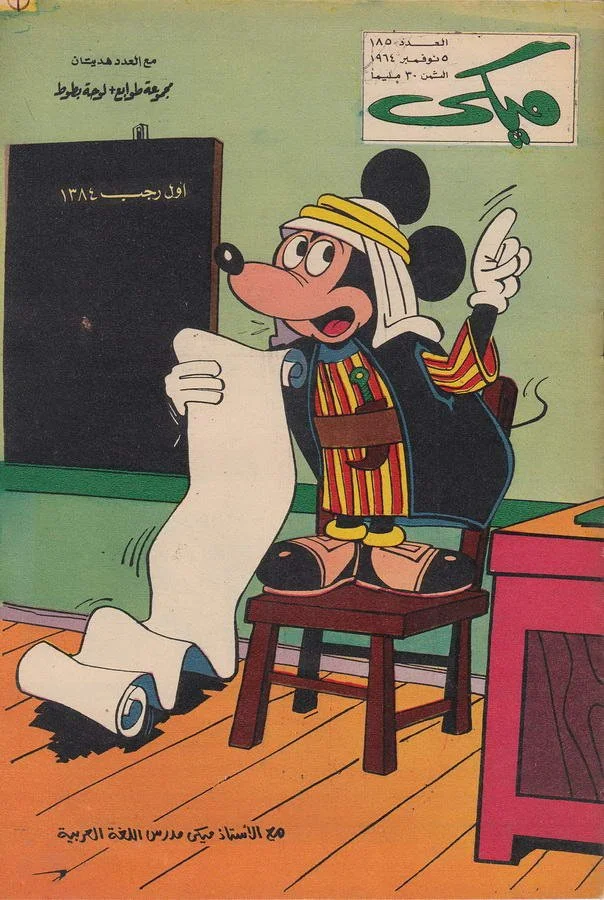
- Made For You and Me: Localizing Disney’s Imperialism for an Egyptian Audience (January 31) - My first article for The Hooded Utilitarian and the foundation of what became my ongoing “Can The Subaltern Draw?” Column. I explore the problematic — but fun to look at — Egyptification of Mickey Mouse into the beloved “Mîkî.”
- Waiting for Nabil Fawzi (April 29) - An updated version of my exploration of Superman’s translation into Arabic by Lebanese publisher Illustrated Publications in the 1970s.
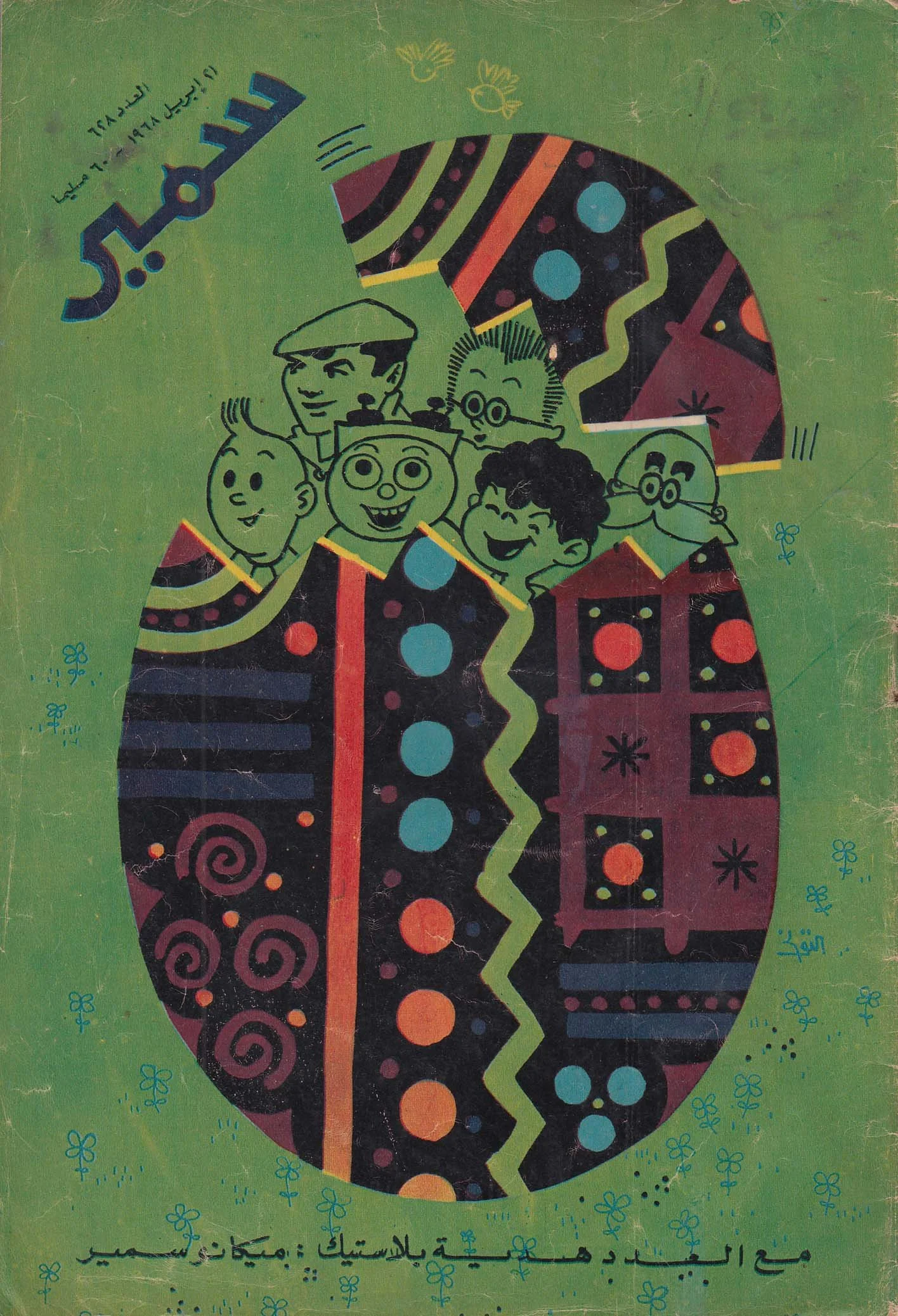
- Samir Magazine and the Art of Bootlegging Tintin (April 16) - An overview of Tintin’s first illegal translation into Arabic (where he became Timtim) by the amazing Children’s magazine Samir. Complete with trippy colors:
- Defining Manhua: A Translated Marketplace in Contemporary China (June 1) - An overly brief summation of the founders of comics (Manhua) in mainland China and a few contemporary independent artists who are furthering their legacy.
- The Case of The Arab Henchman (July 11) - In this twist on an old staple of mine, I look at Hergé’s long history of edits to The Crab with the Golden Claws (now a major motion picture) and particularly how he handles one henchman from the later part of the album.
- Show and Tintin: Tintin’s Footprint in China, Wooden Tintins in Dubai, and Bootleg 丁丁 - I started this “Show+Tintin” series as a brief way to showcase Tintin sitings that were more fun to look at then to write critically about. These are designed to help readers understand just how much of a commercial product the boy reporter is abroad.
- A Survey of Contemporary Arab Comics (September 2) - A brief taste of the amazing comics scene currently renaissancing around the Middle East. Mainly, this is a hopeful launching point for new fans of Arab comics.
- The Spectre of Orientalism in Craig Thompson’s Habibi (October 4) and A Conversation with Craig Thompson on Habibi’s Orientalism (November 16) - These two complementary pieces of writing critically explore the use of Orientalism in Craig Thompson’s Habibi. The response has been a very encouraging and wonderful way to round out the year.
From here on out, I’ll keep a list like this updated in my newly created Index section.
But on to 2012, which for those of you that have read my recent press or attended my recent lectures knows is the year of THE BOOK. Well, my book to be specific. That’s right! I’ve been working hard at turning my Middle East findings so far into a cohesive book which tracks the history of Arab comics from their inception into their recent incarnations, all set up through the lens of Tintin. I will definitely be providing updates as the project develops! Also, in the new year I am looking forward to giving a lot more lectures on Tintin’s travels through “the Orient,” with a few engagements already lined up. All and all, it’s been a great year to be a Tintinologist and I look forward to continuing the pursuit in the new year!
Nate Berg of The Atlantic Cities wrote a thoughtful piece about me and my research this past week. Head over there to read it:
“When you’re made to confront a city versus imagining it, it’s just a completely different experience. It’s more holistic and more totalizing and more complicated than would fit in 60 pages of ligne claire artwork,” Damluji says. “But what I’m interested in is how much of Hergé’s representation of others is not just Hergé. It’s not just the case of one man being racist, but how does this reflect the time in western Europe and how it looks at the world?”
Many thanks to Nate for the write up!
For my column on the Hooded Utilitarian this month I talk with Craig Thompson about Orientalism in Habibi. It was at times a hard conversation to have on my end, but he was so classy about it that it went much smoother than I had any right to expect. A selection:
Nadim: I want to switch gears to talk about Wanatolia and the decision to make it a timeless city, and how that factors into the end of the comic. I was hoping you could articulate how you had the decision for Dodola and Zam to return to Wanatolia and the reveal that it is modern in the western conception, even though at the heart of it is this palace which is backwards.
Craig Thompson: In earlier drafts of the Sultan’s palace, I was mediating on the Bush administration and feeling like it was this sort of clueless world that existed outside of our own society. That was in the aftermath of 9/11 when you would see Bush off golfing somewhere. And certainly some Sultans during the Ottoman Empire have been critiqued historically for being clueless what was happening in society. That’s how the Ottoman Empire fell, the Sultans were living in a hedonistic cushion. By hedonistic I don’t mean they were sleeping with all their courtesans … it’s just the role of Americans and rich people in general that are totally oblivious of the state of the world. In terms of that clashing of the new and old world, that exists everywhere. If you travel to a developing country, you see people living in incredible poverty and living very simple lifestyles similar to 100 years ago brushing up against modernity and global trade. You can see how obviously our consumerist society is feasting off of poverty in their countries and how all our waste is there. Here we just consume and produce a lot of waste and then it sort of disappears and we don’t have to deal with it precisely because we are heaping it on to other people. And that’s a reality… I’m doing a fairy tale or parable version of that, but I don’t feel like it’s dramatically abstracted from the world we live in.
Read more if this intrigues you. And that marks the last writing I will do about Habibi for quite some time. Confronting your idols is a draining business!
On to the next one! After a great few days at the Sharjah International Book Fare, I’ll be in Beirut for the next week to do some more talking and research before returning to the US. This is the great poster that IFPO prepared for the talk. If you’re in the area please attend!
Hey readers! Just dropping in to provide a quick update that I will be talking about Hergé’s imagination of the Middle East in Tintin as well as contemporary Arab comics later this week at the Sharjah International Book Fair from November 15-20. I very much look forward to returning to the United Arab Emirates after my research took me to Dubai and Abu Dhabi last Winter.
While I’m back in the Middle East I will also make a trip to Beirut, Lebanon where I will talk Tintin at the Institut Français du Proche-Orient on November 23. More details to follow on both of these exciting speaking engagements! If you are in the area for either please stop by.
I was reminiscing about Hong Kong today which led me to realize I had yet to post any Tintinography from my stint there. Anyways, here is one that was fittingly taken on one of my last days in the city and one of my last days abroad.
To keep things relevant, here is Tintin posing with the Terracotta Warriors in Xi’an.
Update #2: Earlier this month I wrote a critical exploration of Orientalism in Craig Thompson’s Habibi. It has been (mostly) well-received and garnered me quite a bit of readers and comments! Many thanks to kind links from web luminaries such as The Beat, Bookslut, Comic Book Resources, Arab Lit, and a thoughtful response from Eddie Campbell. A taste of my review:
The question, then, is if Thompson so badly wanted to tell a story about what sex means in the context of love (familial to sexual), survival, and sacrifice, why did he choose this vessel? The answer I come to is that because this was the easy context. The artistic playground he chose of barbaric Arabs devoid of history but not savagery is a well-trod environment in Western literature, and one that is consistently reinforced in the pages of Habibi. In too many panels, Thompson conjures up familiar and lazy stereotypes of Arabs. From the greedy Sultan in his palace, to the Opium dazed harem, to the overly crowded streets of beggars, and the general status of women as property, Thompson layers the book with the hollow caricatures from other literature. These settings are easy to imagine because they have been passed down and recycled throughout much of Western media, so we immediately register these vague settings as natural.
Update #1: In September I published an overview of the contemporary Arab Comics scene on The Hooded Utilitarian:
This new crop of independent Middle Eastern comics spans familiar western formats such as graphic novels, monthly issues, and anthologies, while addressing topics ranging from religion to politics to sex. The survey I’ve compiled here is not complete, but it is a start at cataloguing the wonderful dialogue that is happening right now with comic art in the Arab world. My hope is that what follows can serve as a space for others to add to, comment on, and maybe encourage some space shaving on bookshelves.
For the past 365 days this has been my business card. I’m currently at the Hong Kong International Airport, ready to go back to United States for the first time in a year, and the fact that this has been my job for the last year still seems surreal. Over the past year all over the world I have given this card to many strangers, followed with “No, Seriously.” I don’t know how I would explain to my nine-year-old self, reading Tintin for the first time, that one day he would get paid to pursue a year of travel based around those comics. Frankly, I don’t know how I explain it to my today-self that I ended up devoting a year away from family, friends, job interviews, and overall stability in the name of a dead Belgian man’s comic.
To say this has been my dream job would somehow still be an understatement. For making my beyond dreams come true, my gratitude towards the Thomas J. Watson foundation knows no limits. Through this year of constant travel I’ve learned an immense amount about myself as well as Tintin. I’ve also made friends that will last a lifetime from all corners of the globes, many of whom made what could have been a year of geeky loneliness much less lonely. And to the readers of this blog, thank you so much for your support and likes and comments and e-mails. It’s hard to feel crazy when you have such a wonderful community interested in what you are doing. Thank you all so much.
As for the immediate future, I have a lot more to write on this space when back in the United States. There are interviews, translations, pictures, videos, and a whole bunch of Tintin thoughts left for me explore. Just know that while the writing will be global, I will be doing it from the relatively stable confines of California. Also, I have another big project in the works that I will announce soon enough as well as my ongoing monthly column on The Hooded Utilitarian. In sum, as long as you are willing to keep reading, there will be no shortage of writing coming from me.
Sincerely,
Nadim Damluji. Tintinologist.
More than any other destination I’ve been this year, I found it particularly hard to concretely picture what China would be like before I arrived. I attribute this partially to the noise of Chinese news coverage in the West (mainly about economics, rarely about culture) and partially to my own lack of trying to picture it beyond the overly-abundant Orientalist depictions I’d seen throughout my life. Now that China has become familiar to me and I will soon become geographically distant from it, it’s been an interesting exercise to match up the China which I know with the China I once imagined.
(Source: “The Blue Lotus,” p. 6, B1.)
The China of my imagination was perhaps most vividly influenced by Hergé in the fifth adventure of Tintin (Le Lotus Bleu). For many years the above panel, depicting a bustling city street with rich vibrant colors, was the the image I would conjure up when thinking of China in the abstract. And it was because Hergé first made this panel (with significant help from Zhang Chongren and without actually leaving Belgium) in 1936 that I was able to travel to his source of inspiration seventy five years later and make China concrete. To my surprise, I found that not only was this panel commonly known and celebrated in China, but I could purchase it on a 100% Cotton t-shirt:
Which is to say, in contemporary China, Tintin is a (oft illegal) commodity. If you have been to China before this is very old news. But for the uninitiated, the sheer volume of Tintin memorabilia available in the nooks and crannies of China’s bigger cities can be staggering. There are no official “Tintin Shops” in all of the mainland, but any tourist can pick up enough Tintin-related gear to fill up an extra suitcase. Possibly the most abundant form of Tintin merchandise are mass-produced paintings of album covers. As shown at the top of the post, when in a city like Shanghai or Beijing you will often stumble upon a painting of The Blue Lotus while taking a stroll. Here I present a small assortment of my Chinese Tintin spottings:
Notice here that because these paintings are handmade there will often be slight differences from the original Hergé covers. Above you can notice how Tintin’s face is subtly less shocked than in the original.
The picture above is from a Hong Kong night market, where I was able to briefly talk with the artist (seen on the left) about his process. He showed me how he had taken a cell phone picture of an iconic portrait of Tintin and added his own touch by changing Hergé’s color palette. When I asked him why he painted these Tintin reproductions — like so many artists/sellers I’d seen before him across the mainland — his answer was simple: “My daughter is a big fan!” This answer helped me realize that even though what he is doing is illegal, his motivation was not purely malice or exploitation, but a shared fandom.
The most curious Tintin painting I found was in Shanghai, which took so much creative liberty that it invented a new cover (and name) for an old story. Exit Tintin and Snowy, chased by a bear:
In Beijing, you can ponder how strange these Tintin paintings are over a cocktail at a hip new bar in Houhai with a familiar name:
Before arriving in China, I wasn’t sure if Tintin would be as well-known as in Europe or the Middle East. As I prepare to leave tonight for California, I can confidently say that Hergé’s legacy in China is not only readable, but wearable, frameable, and drinkable.
This is another post for Nadim, the friend who is traveling around the world to learn about Tintin. No, it’s not another picture of him, they belong here.
Last weekend in Stockholm, I stumbled upon a huge collection of Tintin books in Swedish in the centrally located Kulturhuset (culture house).
As a fellow Swedaphile, I thought he might enjoy these (and be inspired to visit his Viking spiritual home one day) - I know I did!
A quick “Show+Tintin” from my dear friend Tom, who secures himself the role of Swedish correspondant until I visit my distant homeland for myself. After a full year of doing this, it is still delightful as ever to see Tintin in a foreign language. Also, it’s fun to see that the once heavily panned “Tintin in the New World” is still getting shelf action in Sweden.
Today’s “Show+Tintin” takes us to the United Arab Emirates. While in Dubai, I heard rumors of Tintin spottings in a local souk or two. Sure enough, I found him (or them) for myself at the Souk Madinat Jumeirah. The souk is a perfect example of Dubai’s focus on polishing the traditional: it’s an air-conditioned indoor mall where one can buy everything from camel magnets to hookahs to other Bedoiun kitsch. In other words, you can go from trying “authentic perfumes” to sipping authentic Costa Coffee lattes without leaving the souk building structure. Nestled in the touristy treasures were many sculptures of Tintin, carved out of wood and sold for negotiable prices.
Of note is that some of these sculptures recast the iconic figure in less iconic roles. While there are multiple statues of Tintin based off his time in Tibet or America, there are also some that do not have a template grounded in Hergé’s albums. For example, here is one of Tintin as a painter:
Also present in the storefronts was Snowy, who I contemplated throwing out a few of my clothes to make space for:
Of course, I couldn’t resist reuniting my non-wooden Tintin with his old friend…
This is the start of a new series called “Show+Tintin,” which will help me back catalogue a lot of the Tintin things I’ve seen around the world as the end of my fellowship year approaches. I’ll post the stray interesting items I’ve stumbled upon over the past year under this heading instead of longer critical articles or glimpses of Tintinography. In sum: less writing, more pretty pictures.
First up, let’s talk about “丁丁” (pronounced “Ding Ding”). As you can probably guess, 丁丁 is the name that Tintin assumed when translated for mainland Chinese readers in the 70s and 80s. Because comics were heavily censored in this post-Cultural Revolution period, the Chinese Tintin translations have a bootleg feel to them (it’s likely that the government knew about these editions but simply turned a blind eye to the proceedings). What most distinguishes this particular translation/transition is not the change of text, but the format of the comics. At the time of the translations, Manhua was most popular in a handheld format that featured only a panel or two per page. 丁丁 conformed to this format, resulting in the most major change to Hergé’s layout that I’ve seen thus far. The panels were carefully adjusted to this new presentation and in some instances make Hergé’s multi-panel gags work better than their original full-page counterparts. Here are some examples of what 丁丁 looks like from Chinese editions of Tintin in the Congo and The Crab With the Golden Claws:
Truly, an album that is problematic in any language.
All of the albums are divided into two separate paperbacks in the Chinese editions.This well known sequence works particularly well with the new format.Hergé’s pseudo-Arabic (aka squiggly lines) is maintained by the translator/s.And the Arab Henchman of course reprises his role for a Chinese audience.
In Shanghai and Beijing you can try your hand at bargaining for these bootleg 丁丁s in most any book or trinket market. All of the albums were translated into Chinese, although some — like “Blue Lotus” — cost more than others. More recently sellers have discovered the value of these bootleg Tintins to tourists and have started selling photocopied reproductions to capitalize. Therefore you can either be vigilant to make sure you get the original bootlegs from the 70s (pro tip: it’s all in the paper) or simply take advantage of the much cheaper reproductions.
In a more recent effort, Tintin re-hit Chinese bookshelves in a completely legal format in 2001 and again in 2010 in an even more legal/better translated version.
It’s been awhile since I posted my Tintinography, so here is one of the boy reporter outside of The Forbidden City in Beijing.
Note: This article was originally published last week on The Hooded Utilitarian as part of my Can The Subaltern Draw? column.
I realized about halfway through a recent interview with Cult Youth founding member Chairman Ca that I was asking the wrong questions. I was nearing the end of my stay in Beijing when I finally got a meeting with Ca, who was seeming more and more like the leader of the only real contemporary comics’ collective in China. In him I sought proof that Chinese comics (or “Manhua”) not only had a present, but a future; a future that would create a discursive political/social space for young critics like it had for so many countries before China. In him I found not the leader of a comics’ revolution, but a very talented dude who likes to make comics about Zombies.
Pages from Chairman Ca’s Zombie Pie
But before we discuss the salience of Cult Youth (CY), it is important to understand the larger comics’ community (or lack thereof) in which they operate. To put it simply, besides CY and a few rare exceptions, there aren’t any contemporary Chinese artists producing comics. However, this doesn’t mean that Chinese people aren’t avidly consuming comics on their iPhones and knock off iPhones alike. You see, the comics that are popular in China aren’t made in China, they’re translated Japanese imports. If you are remotely familiar with the history of China-Japan relations — from The Rape of Nanking all the way to the Diaoyu Islands — hearing that China openly embraces Japanese culture might appear contradictory to popular opinion. And for scholars of Manhua’s history (which you are about to get a primer on!), the reality would seem even stranger. As I’ll explore today, it somehow works that the culture which has youths actively devoting weekends to reading translated Japanese comics is the same culture where you can still read bumper stickers like this:
The history of Manga and Manhua have long been intertwined. The shared heritage should be evident from the name “Manhua” itself, a term adopted by Chinese to approximate the name “Manga” that Japanese caricaturist Hokusai Katsushika famously gave to his depictions of everyday life back in 1814. For a long while after that, Japanese held regional dominance over what was produced under that term, including work like Li De’s strangely Western-like The Rat’s Plaint in 1891. But as Japan-China relations soured under the weight of Japan’s imperial tendencies in the early 1900s, Manhua and Manga saw a clean break.
That clean break is perhaps best exemplified in the clear lines of Feng Zikai, who emerged in the early twentieth century as China’s preeminent comics artist. According to the wonderful Hong Kong Comics: A History of Manhua by Wendy Siuyi Wong, it was Feng’s first published collection of cartoons, Zikai Manhua, in 1925 that better defined ”Manhua” as a distinct art form in Chinese society. Through the work of Feng, Manhua transformed from a loose pan-Asian signifier to describing a specialized Chinese art form with a common aesthetic. I’ll pause here to share some of Feng’s art, which understandably galvanized a whole nation to define a term around it:
These Feng Zikai’s illustrations come via Cultural China and China Online Museum (where I encourage you to take in many more pieces)
Before long, Manhua became a venue for the political as the nation grew increasingly resentful of Japan’s growing regional dominance. In 1927, the Shanghai Cartoon Association — the first cartoon society of its kind in China — formed as a gathering point for a growing roster of Manhua artist. Founding members included Ding Song, Zhang Guangyu, Lu Zhengei, Wang Dunqing, and, of course, Feng Zikai. “The association helped to solidify the loosely organized network of artists that made up the comics industry,” argues Wong in HK Comics, “and it encouraged efforts to raise the quality of its products.” Indeed, the Chinese artists not only used the organization to better their art, but through it explicitly defined Manhua as an art-form and a nationalistic enterprise. Like most nationalistic enterprises, Manhua came to define itself in opposition to other nations; namely Japan. At the Shanghai Animation and Comics Museum the association’s emblem hangs proudly near the entrance with an explanation:
“The association’s emblem is a Cartoon Dragon, representing a caricatured dragon awakening, taking off, determined to fight for the future of the homeland. Members of the association played a leadership role in the cartoon circle at that time, acted as hardcore force in cartoon creation and initiated many periodicals.” (Text from Display)
The dragon awakened within the pages of Chinese cartoon magazines and newspapers alike in the 1930s, determined to fight for its homeland at the start of the Sino-Japanese War. In this especially heated time, many artists became popular for creating anti-Japanese characters. One such artist was Huang Yao, who developed the character Niu Bi Zi. Here is perhaps Yao’s most famous cartoon, which depicts Niu Bi Zi (as China) helplessly crying in the wake of the West’s selfish gutting of the world:
Image via Lambiek
Then there is Zhang Leping, one of the most revered Manhua artists of his generation who is best-known for creating the cartoon character”Sanmao.” For decades the very popular Sanmao represented the struggle of the Chinese people and helped expose the cruelty of occupying Japanese forces. Take for example this typical anti-Japanese Sanmao comic, which shows the Japanese soldiers as senseless and ruthless killers.
Image via Lambiek
The members of the Shanghai Cartoon Association stoked the nationalist flame of China with hatred of Japanese, a fuel source that the PRC has repeatedly used through history when needing to drum up nationalism quickly. The work of these mainland artists from the 1920s until the early 1950s distinguished Manhua from Manga, seemingly putting the two countries in a race for regional dominance in the world of comics.* Today, it takes just one foot inside a Manhua store in any Chinese city to see that the two-way race was won by Japan long ago.
This all leads me back to Cult Youth, an independent Beijing-collective who at first blush looks like a 21st Century incarnation of the Shanghai Cartoon Association. I discovered Cult Youth through this short documentary of them floating around online:
(Click For Video)
Just like the Shanghai Cartoon Association did in the 1920s, Cult Youth have formed a community built around making (and re-defining) Manhua. A productive community at that: since 2007, Cult Youth has self-published three jam-packed collections of work that they sell online. They come across as a rare creative force in an otherwise stagnant market, willing to embrace “DIY” touchstones and break a few rules in the name of putting out relatively provocative comics. “If you were not born in the 80s and couldn’t decode the plots, then give up! This is not for you!,” reads the CY manifesto at the video’s start, “this is a new generation free of the reasons and worries of the past.” In the context of mainland China this bold self-determinative statement feels radical (at least to an outsider like myself). Which is why when I finally met founding member Chairman Ca I was expecting him to embody the language of young revolutionaries, when in reality he was much more modest about his ambitions.
Chairman Ca in his studio.
In my interview with Ca, he politely deflated my suggestions that maybe China was on the verge of a new comics renaissance. Instead, he explained that for him comics are more about a group of friends having fun on the side of their day-jobs, not a potential career path. Ca is an immense talent who has been actively making comics and other art since his days in university, yet he doesn’t keep a portfolio because he doesn’t feel like he needs one. When I asked him about the influence of luminaries like Feng Zikai or where he sees himself in the larger continuum of Manhua he gave me an unexpected answer: “Growing up here we come into contact with more Japanese comics. Only after the Internet became prevalent did we learn about European or North American comics.” Which is to say, the major influences of Ca and Cult Youth’s creative aspirations are not found in the history of Chinese comics, but downloaded copies of R. Crumb and translated Manga. Where the forefathers of Manhua defined themselves in opposition to Japan, Ca represents a generation that defines themselves in collaboration with Japan.
According to Ca the prevalence of translated Japanese comics in today’s market arose because while Manga was establishing itself as an industry in 70s, 80s, and 90s, independent comics were ostensibly made illegal in mainland China. Meanwhile, while the mainland had run dry of original content, Japanese publishers responded to a continued demand for comics in Taiwan and Hong Kong by translating Manga series into Chinese. Hence, Ca and his peers grew up in the mainland with the only new comics available in their language being pirated Manga translations from Taiwan and Hong Kong. Ca’s reference points are then Western reference points: Rockabilly was his first musical love, Zombies are cool, and he identifies philosophically as a Existentialist. For Ca, the fact that Japan is the chief-purveyor of comics in the region isn’t a cultural defeat as older generations would understand it, but simply a reality.
“The industry does well there, it has certain principles and successful cases. It’s easy for young people to turn themselves into that comic industry because it’s an established business,” says Ca of Japan’s Manga market, “For a Chinese person to make a living out of comics it takes a lot of resolute determination to get there. Maybe too much.” Ca’s stance exemplifies a generational shift in Chinese society in the wake of Mao. A generation who now unabashedly embraces Japanese culture through Manga is perhaps the logical extension of Deng Xiaoping’s market-oriented reforms from 1978 onwards: for better or worse, China shifted from a self-contained market to a interdependent player in the world’s economy by opening up. It appears that in the last twenty years the definition of “Manhua” has itself opened up. No longer in a vacuum where it is used as a political tool to encourage nationalism, Manhua is now a term that encompasses a rich history, a translated marketplace, and a few stray youths.
——
* The 1950s marks the formation of the PRC by Mao, and the point where innovative Manhua fled with many Chinese to Hong Kong. While Manhua continued in the mainland during the twentieth century, it was mainly in a bastardized and government sanctioned-only form unlike its early creative years.
A very special thanks to my friend Alec Sugar who served as my fearless translator during the Chairman Ca interview.
And one more Feng for the road:
Here is a mashup of Manhua legend Feng Zikai and The Broken Ear, which also serves as a preview of an article I’m working on.
Hey folks! I have been asked to write a new monthly column over at The Hooded Utilitarian which is called “Can The Subaltern Draw?.” My first piece is an updated version of the Superman post I wrote here awhile back. I’ll link to column every time a new one runs. This is all very exciting for me!
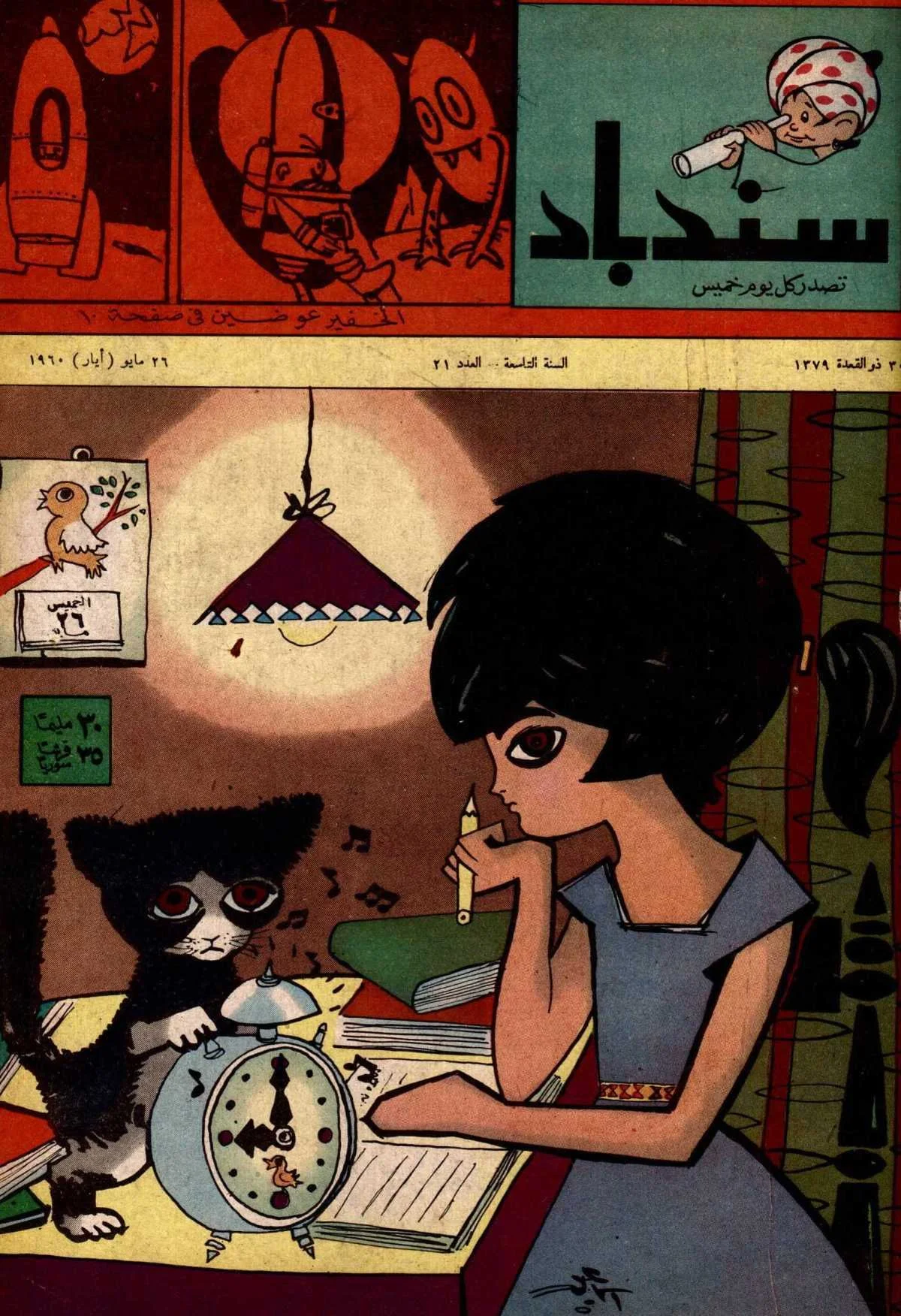
Since at least the 1920s, there has been a rich history of comics in the Middle East. For the first few decades, this comics’ history mostly took the form of political cartoons in newspapers or two-page spreads in text heavy magazines. But in Cairo in 1956, the landscape of Arab Comics was redefined. You see, this was the year that the publishers of Samir (سمير) envisioned a much more expansive role for comics in the Middle East, legality aside.
Out of all the children magazines of the day, Samir is my favorite by a sizable margin. To read an issue of Samir is to read a fully realized, very ambitious, globe spanning sampling of comics from the time. Like its contemporaries, Samir serialized comics month-to-month that were geared towards children (or more specifically their after-school allowance). However, Samir set itself apart by creating a unique international conversation between comics that gave equal weight to European illustrations as it did to those from the Middle East. In other words, a single issue of Samir can take you from a local tale of Jeha (a well-known regional trouble maker) to an adventure of Tintin with the flip of a page.
Instead of putting out a translated-only publication, the publishers of Samir invested in creating original regional comics. Therefore, in addition to introducing Arab kids to a world of comics abroad, the magazine introduced them to a world of comics at their own footsteps. For now my collection of 1950’s Samirs is too scattered around the world (and the online resources are too few) for me to look at these original local comics in greater depth, so I will flip the proverbial page to examine how Samir created Tintin’s first peculiar translation into Arabic.
Remember that time I told you about how Tintin was translated into Arabic legally for the first time in 1979? Well that caveat of “legality” is necessary because from the first issue of Samir in 1956, Tintin was being localized for an Egyptian audience on a monthly basis. These Samir translations differ in two major ways from those official later versions: language and color. To start with the most obvious difference, in getting bootlegged for an Egyptian audience Tintin became noticeably more psychedelic. As if filtered through Professor Calculus’s “Super Calcacolor,”* the colors of the Samir Tintins are distinctively different from their European counterparts. Take for example the transformation of these well-known panels from The Crab with the Golden Claws**(pg.31, C1-3 and pg.32, D1-3):
Before:
After:
Before:
After:
The changes here are stark and wonderful. Maybe it’s the novelty of it, but I sort of prefer the tripped-out Samir versions. This strange colorization may also help explain why a few decades later Arabic Tintin’s were available with every other page decolorized. The other major difference in these pre-licensed Tintin translations is that the Arabic is colloquially Egyptian instead of the universal classical. This gives the cast of Tintin the effect of speaking as if they were Egyptian, seamlessly incorporating local phrases throughout Hergé’s panels.
Although the methodology might not have been legal, I find it deeply encouraging that Samir was the format most Egyptian children were first exposed to Tintin. In Samir, The Adventures of Tintin were given a unique context that put Hergé in dialogue with — instead of opposition to — his Arab counterparts. The publishers of Samir embraced the blurry lines between culture and the result is a magazine that can start with Tintin in a distant land and end with a young Muslim boy praising God.
——
* A very-earned congratulations if you caught the reference:
** In case you were curious, the Arab Henchman made it into the Samir versions:
Updates
-
@samalden last week on stage Joe Sacco calculated the pages he hasn't drawn because of having to walk his dog.
-
Is this the appropriate place to gush about the new Vampire Weekend? Because that album is something special.9 days ago from web | Reply, Retweet, Favorite
-
RT @wwborders: Details on the arrest of Magdy El Shafee from @lissijaquette: http://t.co/RDjxMdGotA #freemagdy4 weeks ago from web | Reply, Retweet, Favorite
-
RT @LevantineCenter: Informative talk on Arab comics, history dating back in MENA to 1920s @NDamluji @arabamericanmus6 weeks ago from web | Reply, Retweet, Favorite
-
RT @AlakhbarEnglish: Arab Comics: Creating Communities, Archiving History http://t.co/BPNilfHTzy #culturesociety #arabcomics #articles6 weeks ago from web | Reply, Retweet, Favorite
-
I didn't know that Justin Timberlake did the soundtrack to "Amour": http://t.co/5GeVDRg9FE2 months ago from web | Reply, Retweet, Favorite
-
RT @theseantcollins: I wrote about @samalden's spectacular webcomic Haunter (and also Boardwalk Empire, for some reason) for Vorpalizer: ...2 months ago from web | Reply, Retweet, Favorite
-
@IslamSciFi Yes there is! You should ask the wonderful (but no doubt swamped) folks at @MEFCC for their list of local Manga exhibitors.2 months ago from web | Reply, Retweet, Favorite
-
2 months ago from web | Reply, Retweet, Favorite
-
@drawmedy @IslamSciFi Per usual I'm late to the twitter party, but let me know if I can be of any help!2 months ago from web | Reply, Retweet, Favorite
-
2 months ago from web | Reply, Retweet, Favorite
-
"Damn I got dishes, damn I got dishes" - listening to Kendrick Lamar in the kitchen.2 months ago from web | Reply, Retweet, Favorite
-
Parallax walks into a bar and is all like, "Man, it's hard to make jokes with fresh perspectives."3 months ago from web | Reply, Retweet, Favorite
-
After both Before Sunrise/Sunset failed to delver on their titles, I hope Linklater has FINALLY made a vampire film with Before Midnight.4 months ago from web | Reply, Retweet, Favorite
-
Was going through some scans today and Sadat decided to pop up and say hello. http://t.co/wzntXFR14 months ago from web | Reply, Retweet, Favorite
-
I exclusively practice my free throws when I have a cold.4 months ago from web | Reply, Retweet, Favorite
-
There is a high probability that Taylor Swift has a consultant to tell her what it's like to be 22. Follow up: how do I get that job?6 months ago from web | Reply, Retweet, Favorite
-
Sometimes art imitates weather patterns.8 months ago from web | Reply, Retweet, Favorite
-
Fall be kind, please: http://t.co/gvTYPghN8 months ago from web | Reply, Retweet, Favorite
Posts
Recent tracks
-
Body Party by {'mbid': '03172286-f7ed-4864-a4db-459cd5ca9790', '#text': 'Ciara'}3 weeks ago
-
How Many Drinks? by {'mbid': '0651fa94-f20c-4793-9dc9-bfcea8d26633', '#text': 'Miguel'}3 weeks ago
-
When It's Over by {'mbid': '0da6296c-a562-4d06-85d2-5e2740885d07', '#text': 'Wild Belle'}3 weeks ago
-
Never Wanted Your Love by {'mbid': 'fb821608-35fd-4a45-a4b2-1a0537cee111', '#text': 'She & Him'}3 weeks ago
-
Get Lucky (Radio Edit) [feat. Pharrell Williams] by {'mbid': '056e4f3e-d505-4dad-8ec1-d04f521cbb56', '#text': 'Daft Punk'}3 weeks ago
-
Cape Cod Kwassa Kwassa by {'mbid': '', '#text': 'Hot Chip & Peter Gabriel'}3 weeks ago
-
Ruby Soho (Rancid Cover) by {'mbid': 'af37c51c-0790-4a29-b995-456f98a6b8c9', '#text': 'Vampire Weekend'}3 weeks ago
-
Islands In The Stream by {'mbid': '1d543e07-d0d2-4834-a8db-d65c50c2a856', '#text': 'Dolly Parton'}3 weeks ago
-
Sweet Jane by {'mbid': '94b0fb9d-a066-4823-b2ec-af1d324bcfcf', '#text': 'The Velvet Underground'}3 weeks ago
-
Father And Son by {'mbid': '5adb8b74-54b8-4700-836e-550b6a2a2f71', '#text': 'Cat Stevens'}3 weeks ago
Top artists
Photos
The Hooded Utilatirian
Nadim is a college graduate with a degree in Politics, who is now travelling around the world with a research grant to study the colonial implications of The Adventures of Tintin.
Don't hesistate to E-mail.